
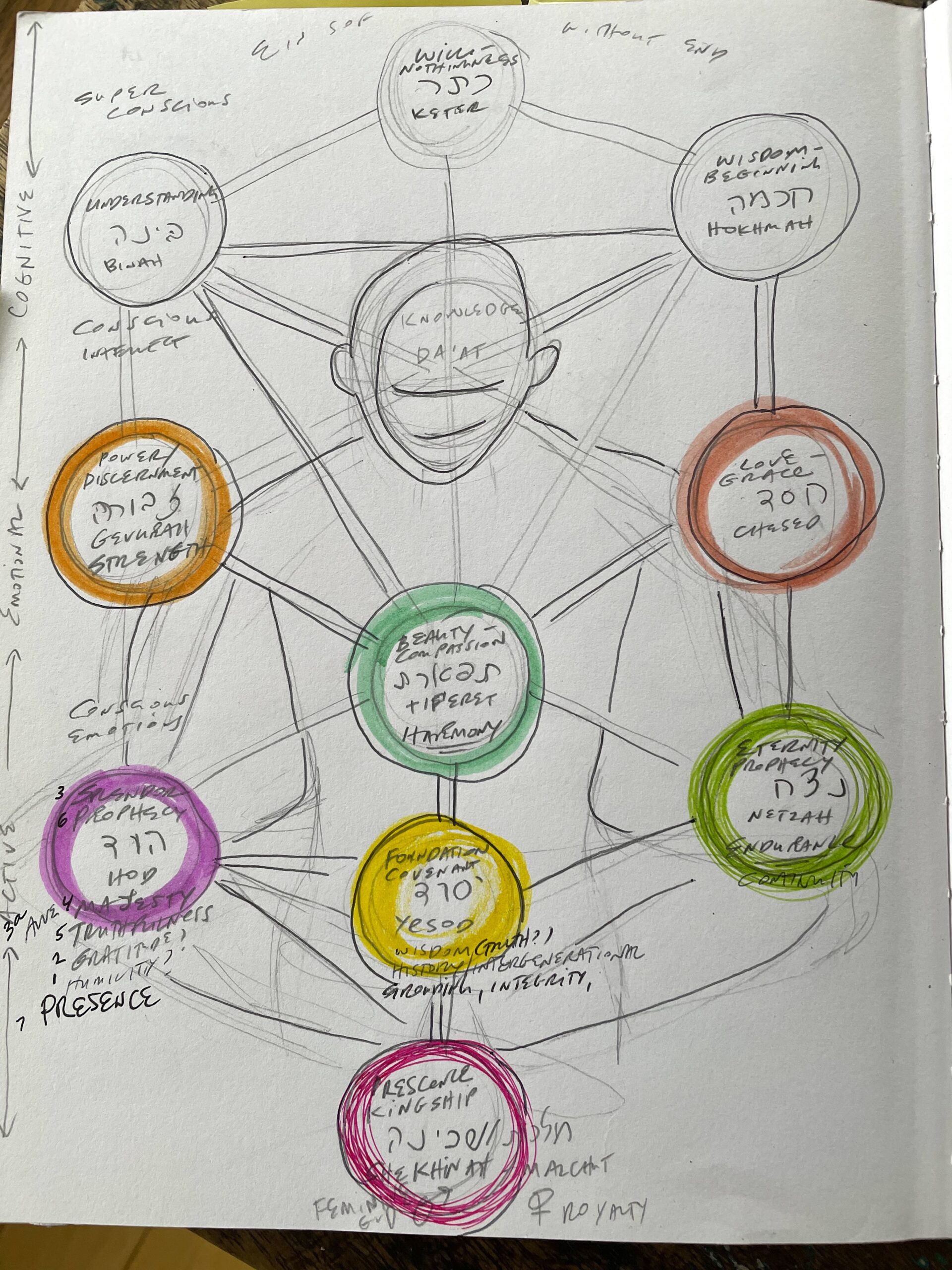
Counting the Omer – the 49-day period between Passover and Shavuot – is a Jewish tradition that’s played out in different ways over time. For our ancient forebearers counted these days as part of an outward-facing agricultural pursuit; an omer was literally an offering of grain made in recognition that forces beyond us control the harvest. For the medieval Kabbalists it was a time for internal evolution; the lower sefirot, divine emanations, on their Tree of Life provided a metaphorical pathway parallel to the 40 years of wandering, a bridge between the liberation of the Passover exodus with the revelation of Torah at Mount Sinai.
Each week of the 7-week cycle is devoted to a sefirah – Chesed, Gevurah, Tiferet, Nezach, Hod, Yesod, Malchut. And each day within each week we contemplate that week’s sefirah in relation to the other 6. For example, Day 1: Chesed sh’b Chesed (Loving Kindness within Loving Kindness), Day 2: Gevurah sh’b Chesed (Strength within Loving Kindness), Day 3: Tiferet sh’b Chesed (Beauty within Loving Kindness) and so on. There are many definitions for each attribute (for example chesed can be understood as boundlessness, grace, mercy, compassion…) yielding countless ways to “read” and respond to the teaching.
For this year’s Omer, we’re excited to share the voices of 7 members of our community, one each week. We hope their words provide inspiration for your own spiritual spring cleaning, making way for the expansion necessary to help you break free from the Pharaoh’s we face today.
WEEK 1: CHESED (Loving-Kindness)
an offering from Joanie Calem
Back in September I responded to an email from Ritualwell (a project of the Reconstructionist movement), inviting communities to participate in a new Jewish Writers’ Circle project. The series was set up to help participants explore different Jewish texts as prompts for writing exercises. The most recent text we received was very thought-provoking, and in reading it I immediately felt the connection to the sfira of CHESED (Loving-Kindness), the sfira that has always spoken loudest to me.
It came from BeReshit Rabbah, a collection of rabbinic interpretations from sometime between 200-500 CE. In it, the rabbis discuss Genesis and recognize human nature as being multifaceted, analyzing yetzer hatov (a good inclination) and yetzer hara (a bad inclination). The selection we were given reads:
“Rabbi Nahman bar Shmuel bar Nahman said in the name of Rav Shmuel bar Nahman: ‘Behold it was very good’ – this is the good inclination; ‘and behold it was very good’ – this is the evil inclination. Is the evil inclination, then, very good? This is a rhetorical question. Rather, were it not for the evil inclination, a man would never build a house, would never marry a wife, would never beget children, and would never engage in commerce.”
According to my understanding of yetzer hara here, it is as though yetzer hara is the energy that moves us to accomplish big external things or, in modern terms, it might be that yetzer hara could be considered the ego that wants to do things, has goals and aspirations, and requires us to interact and work both with and against the goals and aspirations of others around us. Finding a balance between being content with what is vs. wanting to change things and grow and acquire new experiences creates that constant juggle between yetzer hatov and yetzer hara within ourselves. But we don’t live in a bubble all alone, so figuring out how to balance our own yetzer hara with that of others, especially those who might seem to be trying to take us and others in a direction that they consider correct but we consider evil, is a whole ‘nother kettle of fish.
What does all this have to do with CHESED one might ask? To me CHESED is about how I treat others, and with what kind of attitude I approach others. We all know how easy it is to be kind and inclusive when we like another person and like what they are doing and the vibe they put out. It is easy to be kind when other people are kind to us. But the sfira of CHESED invites us to stretch out of that comfort zone.
To me, life is a daily adventure of events and people that appear in my trajectory. I might leave the house in the morning thinking that I know where I am going and who I am going to interact with, but there are always surprises, and always unique events that test my ability to relate with CHESED to whoever is in front of me. If I am moving forward with yetzer hara, that achievement oriented part of myself, and someone else is doing the same, but in a way that gets in my way…what pops up? Yetzer hatov or yetzer hara?
Every moment spent in community, every moment walking down the street, every moment reading the news…all an invitation to bring CHESED into the world. I am looking forward to this period of counting of the Omer to see how CHESED will be needed.