
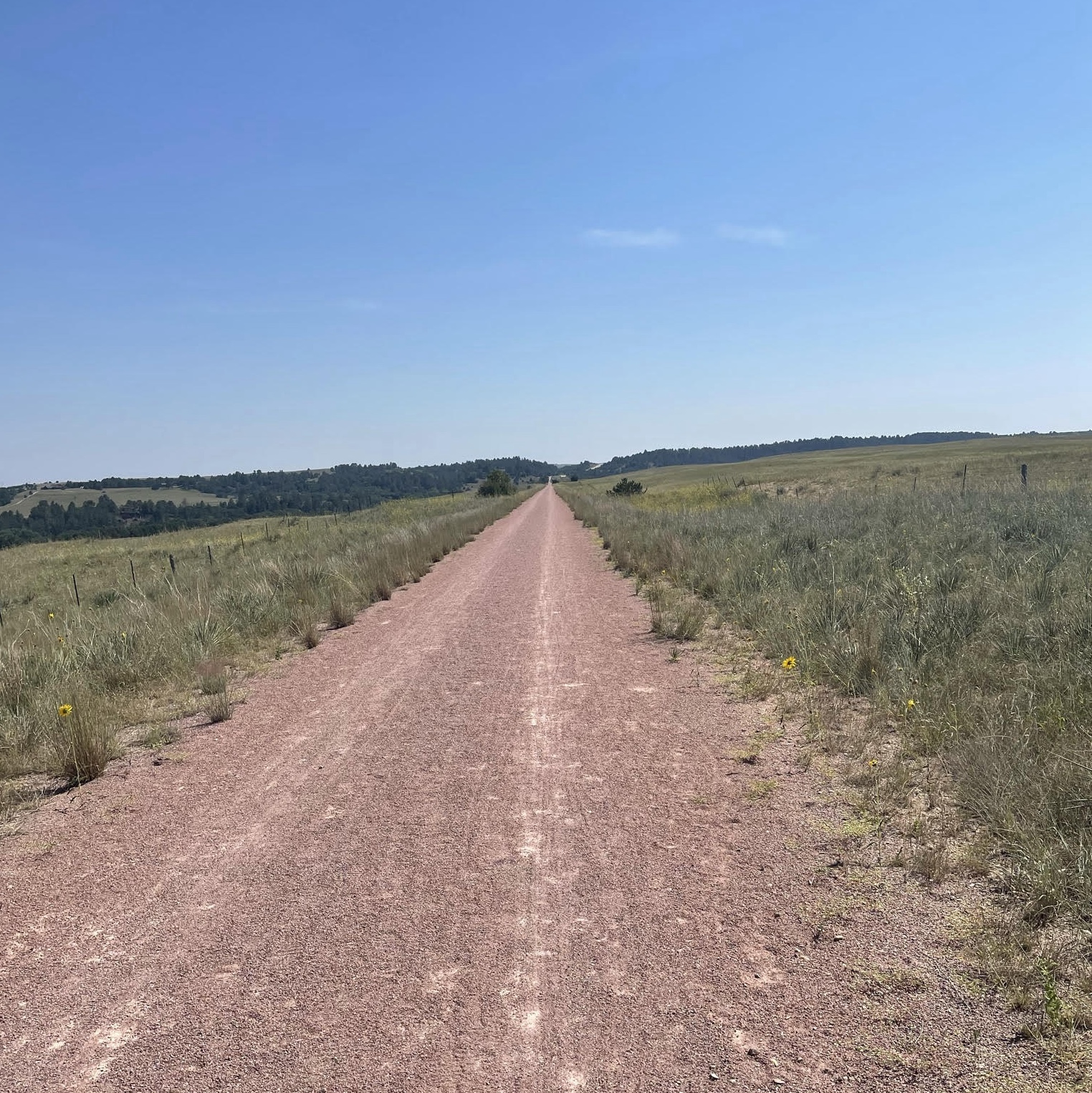
on the Cowboy Trail in northern Nebraska
When it came to curating an author to write about Netzach, I immediately thought of Doug Calem. As many readers know, in 2021, at the age of 61 Doug completed a cross-country bicycle trek that required lots of Netzach – often translated as endurance. He wrote a, hopefully soon to be published, book based on that experience. While you wait, follow his “Riding Through Dreamland” blog where he explores themes from the book. In the end, Doug chose not to share more here about how he “endured that 10-week, self-imposed sufferfest.” Instead, he was compelled to write about how he is experiencing netzach in the face of the many challenging, sustained fronts we face today.
Netzach: “…the willingness to put in sustained effort, even when things are challenging. It calls on long-term vision and perseverance.” – Judaism Unbound
There is a tightly wound faultline that cuts in multiple directions these days. A tension that we personally cannot resolve and often feel powerless to address in any significant manner. I feel this way as an American Jew who is also an Israeli citizen on the heels of the US-Israeli war on Iran and the fascist strategies the State of Israel employs to oppress Palestinians in the West Bank and destroy Gaza. I also struggle with holding the tension between the clear evidence of how the earth is poisoned with plastic and the deaths that take place daily from this toxic industry and the work I do as a reuse activist. How does one remain steadfast in the face of complex, systemic forces that contain so much incoherent energy?
For me, netzach begins with understanding that there is no life without tension, especially the tension resulting from what we define as “opposites.” Governed by the laws of physics, we move through space and time in the Universe’s ocean of electromagnetic energy, forever flowing between the poles. This, in turn, has created in us a default outlook that focuses primarily on the significance of these poles (i.e., “you have to pick a side”) and less on flow that occurs naturally between them (i.e., the uncertainty of nuance).
As an American-Israeli, I find myself increasingly repelled by the intolerance of criticism of Israel on the part of American Jewry. Guided by a mindset of perpetual victimhood that, for example, inserts an “11th plague of antisemitism” into Passover haggadot, the establishment professes that if you do not support Israel, you are somehow a “bad Jew.” This is an example of identifying with one pole.
From 1983 -1985 I worked in Israel developing Jewish-Arab relations. I learned Arabic and lived in a Palestinian town. This helped me develop empathy for people I was warned would literally stab me in the back (the worst they ever did was to over-caffeination me). That experience of living as the minority – coupled with my childhood as an American in Puerto Rico and my current life as an adult with a disability, have all helped me develop an appreciation for nuance. Which is why it is annoyingly frustrating to me to see the cycle of violence and myopic policies spin ceaselessly.
At the time I was trying to bring Israeli Jews and Arabs together, I honestly (and naively) thought there would be peace in my lifetime. I no longer hold this view. “Ok,” I tell myself now, “if not peace, then I am happy to settle for gradual improvement.” Yet the reality is that “the situation” (hamatzav, as they call it in Israel) has only gotten worse. It takes so much spiritual stamina and emotional perseverance not to succumb to the desire to dig a hole and bury my head in the sand. What can one person do?
The truth is we are never just “one person.” Community and collective action are what empower the stamina and sustained effort of netzach. Sukkat Shalom is a good example of how a community of people can create coherent energy that, despite the collective turbulence it sometimes generates, is a (re)constructive force. I find this to be true in my work co-directing the Central Ohio Reuse Coalition with Dan Barash. We have created and implemented a workable circular model that serves as a counternarrative to the status quo that is our disposable culture. Even so, the exponential increase of plastic production is sobering, and I wonder if there’s truly any hope as we are fast approaching the end of the runway to avoid the catastrophic effects of climate change. How do we sustain netzach amid the all-too clear signs of environmental ruin?
We should never simply resign ourselves to perpetual war and environmental ruin. Netzach does not imply we should simply come to terms with that which we abhor. I find that understanding and appreciating the nature of things – such as the awe I feel when looking at photographs of galaxies in their seemingly timeless dance through deep space — helps me persevere. The nuance of, on one hand, the fact that things here on earth right now matter so much AND, at the same time, staying aware that “life goes on within and without you” (thanks, George Harrison) acts as a potent reminder to keep carrying the load of our personal and social responsibilities — without thoughts of results.
For netzach and for life, it’s the journey – the one we simultaneously take and create — that matters in the end.