
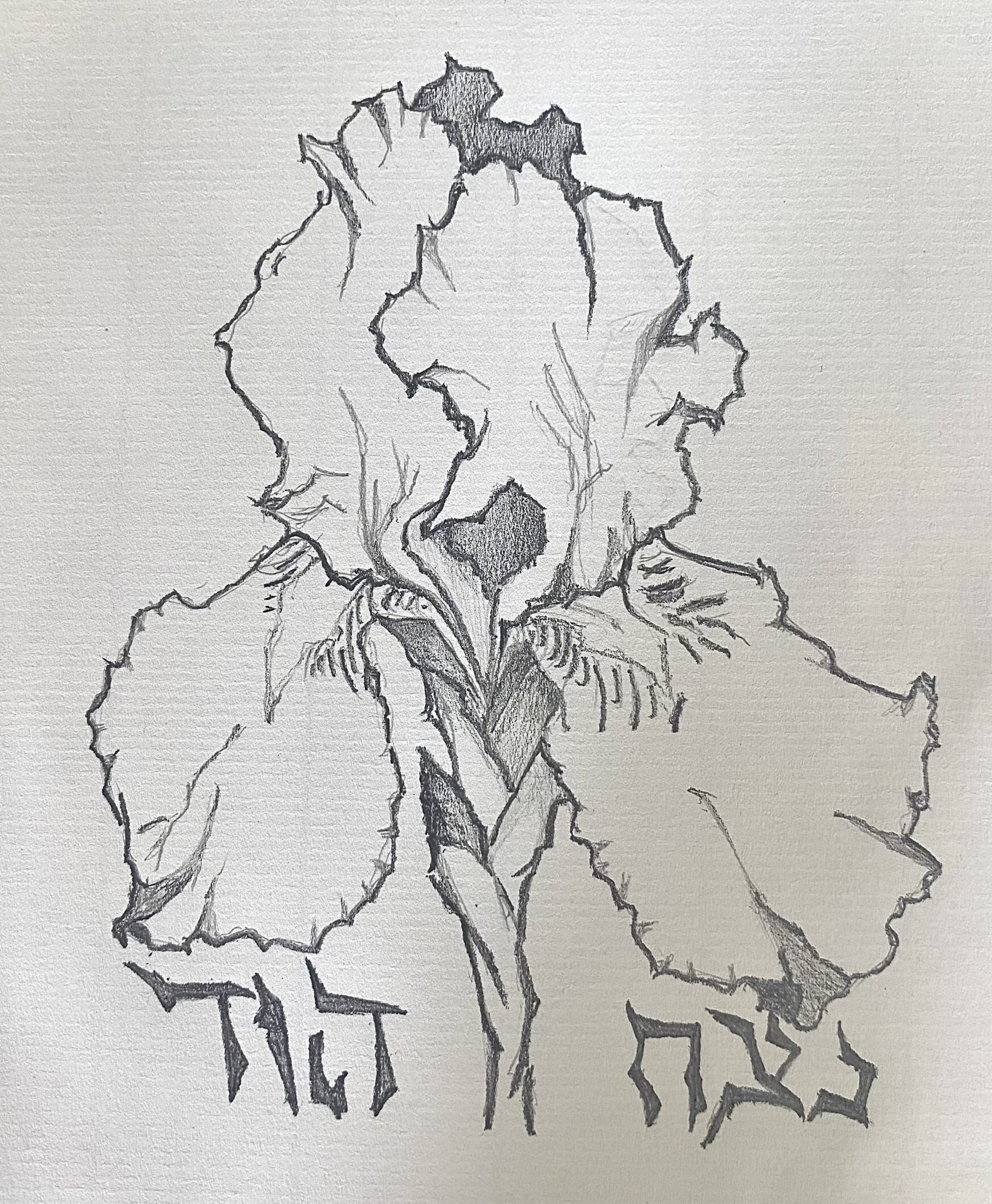
This week’s post comes from another new voice in our community. Ian Ghidossi made his leadership debut in Sukkat Shalom at our Adult B’nei MItzvah in March. His offering here is at once deeply personal and universal. He draws a clear connection between last week’s sephirah, Netzach, and this week’s, Hod, helping us seeing how opening ourselves to moments of divine revelation in our daily lives can help us keep going.
I recently found myself in the midst of a depressive episode. To be clear, that’s nothing new to me, I’ve lived with depression since late adolescence. But the symptoms are, after years of treatment, ever more unwelcome in my body. I take sharper notice now of the heaviness of my limbs and the waning of joy, passion, and humor as a grayness blankets over every waking moment. When its grip is tightest, days lose their distinction and feelings flatten. It goes on and on like that. Until one morning when I am out walking my dog, my eyes are met by an iris in full bloom. Its petals are pink and plum colored, and yellow where they pinch together. In the gray plain of my mind, sparks flash, hot and orange. Wonder. For a moment, I am shaken awake by beauty. Breath fills my lungs.
Springtime in Columbus reminds me of this feeling – an exceptional moment after the long, gray slog of Ohio winter, short and intensely colorful, gone too quickly. I’ve admired Columbus’s gardeners since moving here from New York City in 2018, how they seize upon the few weeks of bloom we are allotted each year. Perhaps it is our particularly drab winter sky that inspires them to tend to trees that explode with pink and white blossoms all over town like fireworks stuck in time, or the biting winds that move us to light fires of tulip, daffodil, peony, and iris.
In this month of ‘Iyyar – from the ancient Akkadian for “blossom” – we welcome the warming of the land and our bodies. In this fifth week of counting the ‘Omer, we reach our last frost and gather to celebrate Lag B’Omer around the bonfire.
The Qabalists assigned this week the sefirah of Hod, often translated directly as “majesty” or “splendor”, but perhaps better understood in this context as the attribute of reverence and humility before (divine) beauty. Springtime is a season poised for gratitude and joy, a time of such concentrated beauty that many cannot help but stop in their tracks and admire the scent of lilac on the breeze. Its majesty reaches out to us wherever we happen to be when it arrives. But spring is also ephemeral, so, how can we take the lessons of hod that springtime offers into all of our seasons?
For this, I want to offer some further reflections on modeh ‘ani, building on those I shared in my presentation at the adult b’nei mitzvah service we held last month. Modeh/ah, meaning “(I am) thankful”, shares a root with hod, both Hebrew words having to do with acknowledgement. On that Shabbat in March, I talked about my daily practice of reciting the twelve-word prayer for waking up in the morning, focusing then on how it had become a way for me to engage with the Divine as a self-identified agnostic. I did not discuss depression then by name, but adopting this ritual has served as another tool for managing that condition. Modeh ‘ani is, at its core and in name, a practice of gratitude for life and a daily means of checking in with the mind and the body.
Depression cools passion for life, weakening that fire until only embers remain, extinguishing even the tiniest sparks. It takes a variety of tools to stave off the chill. Therapy, medication, and, yes, spiritual practice, can all serve important functions. With this one ritual, I’ve developed a habit of showing gratitude for the most essential component of life in our tradition, the very breath in my lungs. Shehechezarta bi nishmati b’chemlah goes the middle phrase, “for You have restored my soul/breath to me with compassion”. Some mornings, acknowledging the gift of breath is enough to light those sparks again.
It is not always so simple though, just as in my encounter with the iris, some days those sparks fade. Oftentimes, lighting a fire takes a few attempts. Hod does not sustain us alone, we also need netzach – endurance, consistency. These two sefirot are an inseparable pair, the two hips, or legs, of the Qabalistic tree of life, providing balance and enabling forward momentum. Both are built into the practice of modeh ‘ani as a daily, sustained effort to recognize majesty in the continuity of our breath.
I am called back to that patch of flowers when I am out walking now, not because the sight of them cured me of my ills, but because they reminded me in an instant, however short, of the feeling of being alive. On the other side of a depressive episode, their hod serves as a small reminder of all the effort, love, and community that’s carried me out of so many lows. And though they will wilt in the coming weeks, I will move forward grateful to have witnessed them at all.