
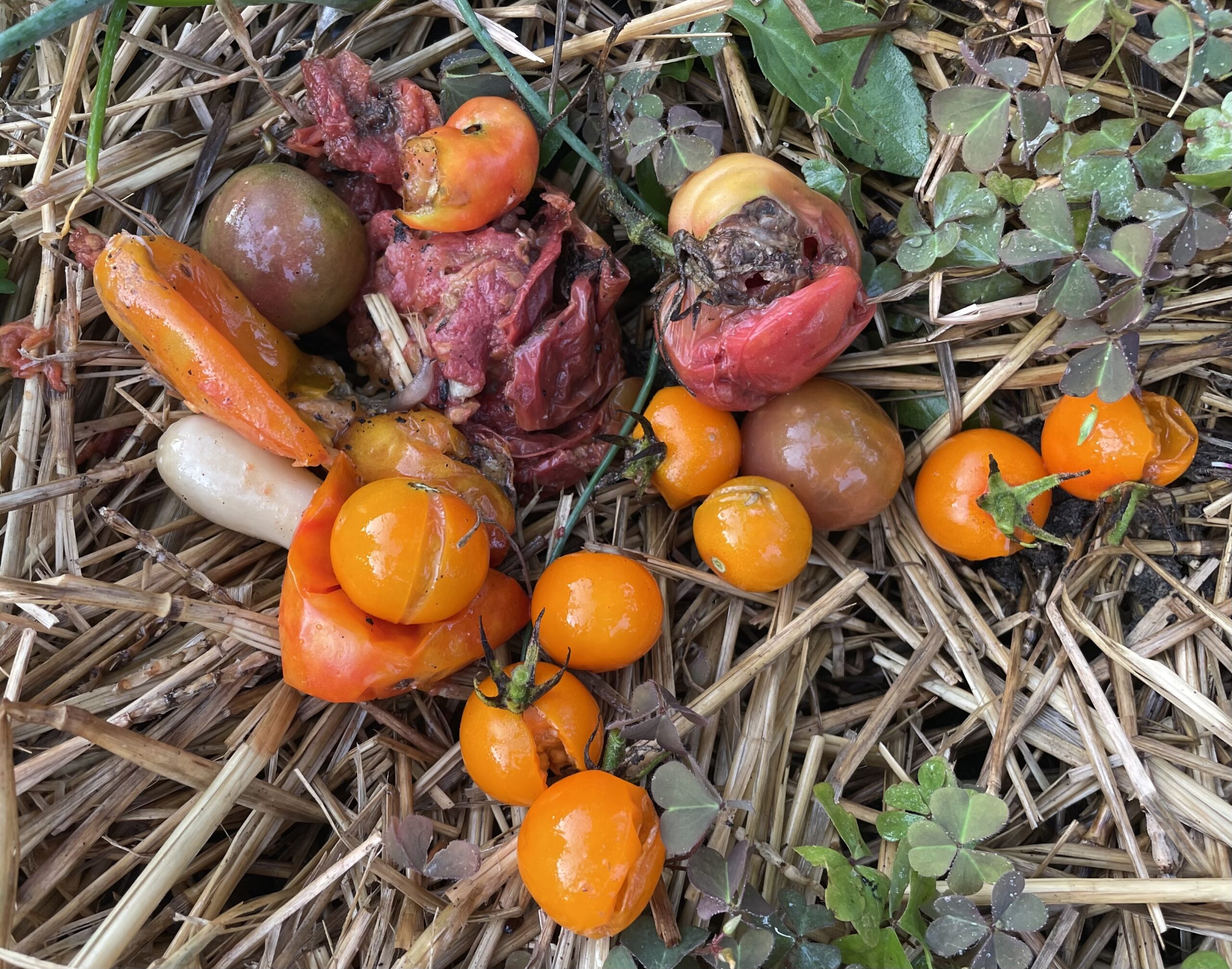
It’s minhag (tradition) in our community to read Marge Piercy’s poem “Coming Up on September” during our Rosh HaShanah services. The poem ends with these lines:
The New Year is a great door that stands across the evening and Yom Kippur is the second door.
Between them are song and silence, stone and clay pot to be filled from within myself.
I will find there both ripeness and rot,
What I have done and undone,
What I must let go with the waning days and what I must take in.
With the last tomatoes, we harvest the fruit of our lives.
During these in-between days, we’re sharing words from Annie Prusky, our rabbinic intern this season. This sermon which she shared on Rosh HaShanah, carries one message of those last tomatoes forward; connecting composting with teshuvah – the process of reflecting on, repenting for, and making efforts for repairing our thoughts and actions. We hope reading her words might bring focus to your own practice of turning into the new year. G’mar chatimah tovah.
Every day, after I pick my son up from daycare, I bring him home and pull into our back alleyway. I get out of the car and am immediately confronted by my neighbor’s tomato plant. I’ve watched this plant grow from an empty plot of dirt into seedlings, then stalks, climbing the trellis, blossoming and finally growing fruit. So. Much. Fruit. At first it was delightful, but these last few weeks, all I can see is the waste.
Gorgeous red tomatoes, splitting on the vine or dropping down into the dirt. I can’t keep my eyes off them, even as I get Zev out of his carseat. He reaches for them, and I have to redirect his little hands away from the fruit decomposing on the ground, covered in ants and flies. Sometimes I slyly pick one of the safer tomatoes for us to share as a snack, but the summer heat ripens them faster than they could possibly be eaten.
To be honest with you, my initial reaction was judgement – almost anger – at the perfectly good food going to waste. But I’ve learned a lot from this little tomato garden thanks to Robin Wall Kimmerer, a Potawatomi scientist and storyteller whose writing highlights the wisdom of plants and Indigenous traditions.
Kimmerer teaches that nature doesn’t operate in scarcity or human embarrassment but rather in an endless, reciprocal loop of gifts. Her perspective helped me shift my own. The tomato plant isn’t a waste at all, but a beautiful display of abundance. There are enough tomatoes to feed my neighbors and myself, to share with my son and the ants and the birds and the squirrels. Fruit that drops to the soil and decomposes is the plant feeding itself – seed stock that ensures healthy sprouts next spring.
Today I want to share some of the lessons on teshuva I’ve learned from these tomato plants. But first, I want to share what not to do.
We’re gathered today to celebrate Rosh Hashanah. The Jewish new year, unlike the secular one, arrives in the middle of the harvest. The messy abundance of this season stands in sharp contrast to the pristine blank slate of January 1st. A restart in winter aligns with the persistent cultural idea that a reset means throwing everything out and starting from scratch. But this mindset can have disastrous results.
There is a famous story in the Talmud, in Tractate Shabbat, about Rabbi Shimon bar Yochai and his son Eleazar. To escape Roman persecution, they spend twelve years hiding in a cave studying and teaching pure, uncompromised Torah. When they finally step out, the first thing they see is an ordinary farmer: plowing his field, tending dirt, sweat dripping into his eyes.
Rabbi Shimon is filled with righteous fury. He looks at the gardener and is horrified that he’s spending time planting when he could be studying or praying. He shouts: “These people abandon eternal life to engage in the mundane?!” Every place his gaze lands immediately bursts into flame. Seemingly by virtue of his incredible study, he has acquired actual laser vision.
Before he can reduce the whole country to ash, a heavenly voice – a Bat Kol – shatters the air: “Did you come out to destroy My world? Go back to your cave!”
God banishes the great scholar back underground. Rabbi Shimon’s “holy fury” was really spiritual perfectionism dressed up as piety. He got a reset, and he expected the world to follow suit.
But God made a world that requires sweat, and dirt. The world operates in continual cycles of growth, decay, and renewal.
Nature never throws everything out to start over. It evolves quietly, adapting slowly to better suit its environment. Plants grow from detritus, transforming yesterday’s fallen matter into today’s leaves and stems.
We can imagine teshuvah in that exact same spirit: an ongoing act of cultivation. We can use the fertile ground of our former and current selves to reach toward who we want to become.
During Elul, we might be tempted to aim incinerating eyes at our own hearts. We look at our messy, unfinished year and want to burn the whole thing down to ash. But what if, instead of Rabbi Shimon, we turn to the gardener for guidance?
Let’s go back to my neighbor’s tomatoes. Fruit that drops on the ground is the start of a natural compost cycle. With oxygen, moisture, and time, microorganisms can transform what looks ruined into a gift.
This is a lesson we can use. We can examine the fallen fruit of 5786 – the mistakes and the failures – and rather than shame, we can approach them with curiosity. We can ask: What nutrients are hiding in this misstep? What can I learn about myself?
Mistakes are rarely pure malice; they are almost always clumsy attempts to meet a genuine human need.
Consider a moment when you picked a petty argument, or boasted compulsively at a dinner party. If you look closely at that bruised fruit, you might see your inner child throwing a tantrum because you wanted attention. Turning the compost over, you might discover the longing to feel seen and valued. Can you turn that need into something better this year? Maybe you can call a trusted friend and say honestly, “I’m having an insecure day and could really use a reminder that I matter.” Or find an hour with someone who loves you loudly, no performance required.
When we compost these missteps, we build a better understanding of ourselves. Ah, I see. I wasn’t my best self, but there was a reason. I was lonely. I was overwhelmed. I was running on empty. We can turn this self-knowledge into fuel for a better year ahead.
Part of why my neighbor’s garden produces so much fruit is the strong and sturdy trellis they built to help their plants get as much sun as possible. Without structure, we can’t expect a tomato plant – or a human – to grow perfectly straight. We need scaffolding, like a trellis, to support growth towards better habits.
On a personal level, a trellis means building yourself a scaffold. If you know you wake up irritable, don’t demand immediate cheerful affirmations and disciplined exercise. Instead, gift yourself twenty minutes of grumpy coffee time before your day really starts. If you don’t like your energy coming home from work, the trellis might be sitting in your car for three minutes of deep breathing before you cross the threshold.
On an interpersonal level, a trellis means offering scaffolds that help others understand us. We can state our needs directly instead of expecting our partners or friends to read our minds. We can ask for a break and to revisit a conversation over the weekend. We can tell a friend, “Hey, that comment is still bothering me. Can we talk about it?” Clear expectations encourage people to climb toward better, together.
My neighbor’s tomatoes grow beautifully, thanks to their trellis. They produce an abundance of tomatoes. And so we return to my daily concern: What do we do with the harvest?
Our consumer culture tells us to collect everything we can and pack the cellar until the door barely shuts. But we don’t have to live like that.
This “problem” of abundance reminds me of a report that linguist Daniel Everett wrote as he was learning from a hunter-gatherer community in the Brazilian rainforest.
A hunter had brought home a sizable kill, far too much to be eaten by his family. The researcher asked how he would store the excess. Smoking and drying technologies were well known, so storing was possible. But the hunter was puzzled by the question – store the meat? Why would he do that? Instead, he sent out an invitation to a feast, and soon the neighboring families were gathered around his fire, until every last morsel was consumed.
This seemed like maladaptive behavior to the anthropologist, who asked again: given the uncertainty of meat in the forest, why didn’t he store the meat for himself?
“Store my meat?” replied the hunter, “I store my meat in the belly of my brother.”
I feel a great debt to this unnamed teacher for these words, and to Robin Wall Kimmerer for passing them along to me. Sharing transforms surplus into community.
This insight beats at the heart of our own tradition, too. Long before modern safety nets or grain silos, biblical agriculture built community survival directly into the soil through two sacred practices: Pe’ah and Leket.
Picture an ancient field at harvest time. Stalks of grain blowing in the wind, and just a few short weeks to harvest it before the rain comes. But Biblical law forbids you from collecting every last sheaf.
First came Leket – the practice of gleaning. As you swung your sickle and tied bundles of grain, stalks would inevitably slip through your fingers and fall into the dust. The human instinct is to turn around, bend over, and gather every dropped ear. The Torah said: Leave it. Keep walking. The dropped fruit, the missed sheaf – it belonged by law to the stranger, the orphan, and the poor.
Then came Pe’ah – the commandment of the corners. The Torah instructed you to stop before you finished your field. You left a standing margin of wheat untouched at the edges, standing tall in the sun. Same thing for grapes – the rows on the edges left untouched – or olives – several branches left still laden with fruit. Those unfinished margins were for those who didn’t have a field of their own to harvest, but still needed food for the winter.
The Torah explicitly forbids stripping the land bare. An unharvested edge is an acknowledgment of abundance meant for someone else: the bird, the neighbor, the soil itself. In Jewish law, leaving Pe’ah and Leket is an act of structural justice and community care.
We can bring the holy rhythm of Pe’ah and Leket into our modern lives.
We can practice Pe’ah with our time. Living with a margin means refusing to schedule ourselves to one hundred percent capacity. If our calendars are wall-to-wall, the first emergency wipes us out. When our calendar is blessed with an open afternoon, we don’t need to harvest every second of that time into productivity. We can leave ten percent of our weekly schedule and emotional bandwidth unharvested to create room for the unexpected knock at the door, the spontaneous phone call, or the kid who needs help.
We can practice Leket with our financial resources. When an unexpected surplus drops into our hands, we can resist the urge to build a higher fence around our savings. Instead, we can let it fall into the community. We can put that abundance into the belly of our neighbor: investing in mutual aid, supporting the spiritual home here at KSS, opening our dinner tables, and funding justice work.
And we can demand both Pe’ah and Leket in our civic life. When we find ourselves with political power, even a small amount, we can channel it toward solutions that nourish the entire ecosystem. We can strengthen the social safety net through initiatives like municipal financial counseling and local eviction defense. We tend the common soil when we create welcoming pathways to citizenship for our immigrant neighbors and build on the success of Issue 5, funding community crisis intervention instead of over-policing. These are the civic trellises that lift everyone up.
We know our power and safety do not lie in police, militaries, the borders of any nation-state, or the oppression of others, but in solidarity and community, wherever we live. In Ohio as in Israel and Palestine, genuine security is mutual. Safety grows when we invest in Palestinian freedom, too, recognizing that our collective survival is intertwined.
All flourishing is mutual. The health of the whole ecosystem – of our whole world – depends on the way we tend our gardens.
As we step into 5787, we can remember the ancient wisdom of Rabbi Tarfon: It is not your duty to finish the work, but neither are you at liberty to neglect it.
We do not have to complete the garden today. We only have to keep tending it – patiently, sustainably, and together.
May we enter this new year unfinished, leaning on the scaffold of this community, and blessed in our holy, beautiful imperfection.