
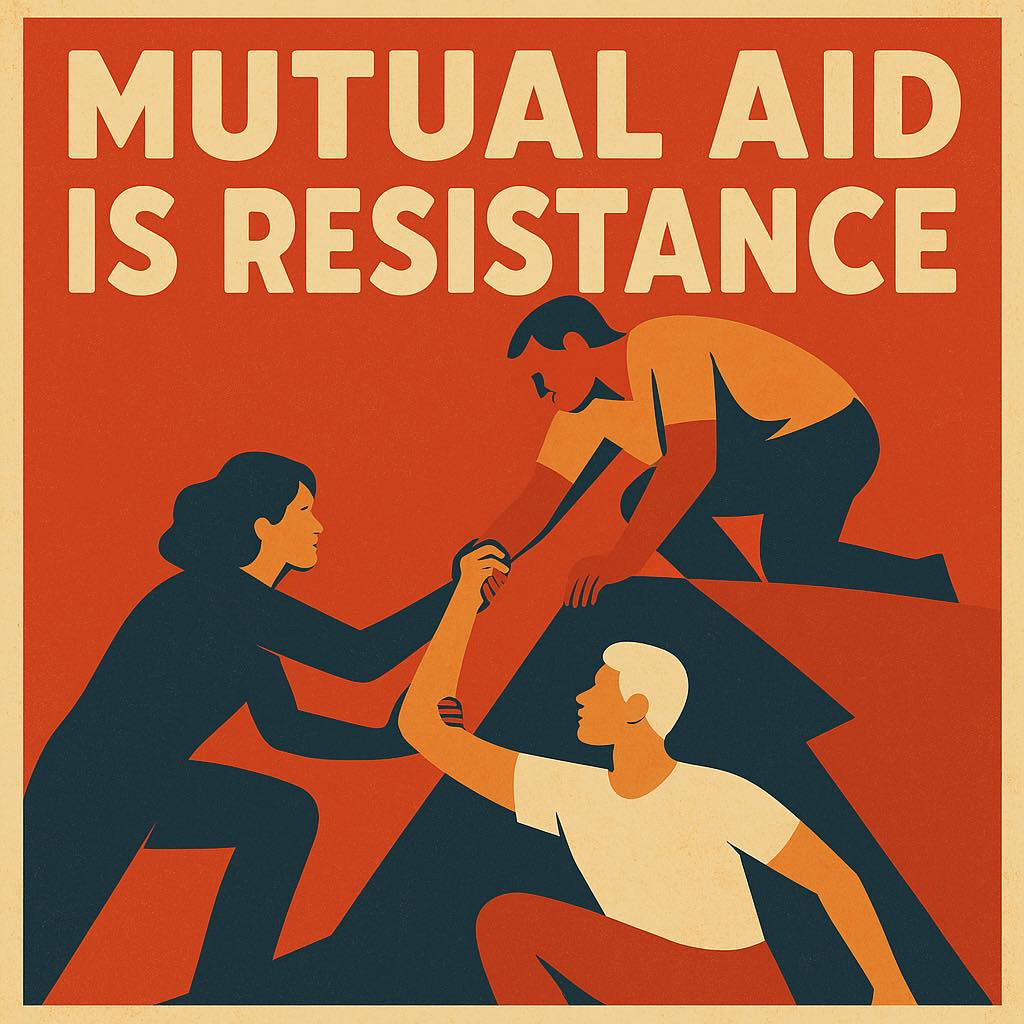
Image credit: Minnesota Indivisible Alliance
Holy wow. The past six weeks have flown by. It’s been an honor to curate this series of Omer offerings. If you missed any I hope you’ll go back and read them all. I feel blessed to be in community with those who shared their reflections with us and for the folks who amplified the messaging by bringing ideas they encountered up in conversations and correspondence the past month and a half. With each Omer cycle I feel myself tuning in more strongly to my best self, getting closer to my full potential. I hope you feel that too.
Our final author is Danny Caine, another voice new to KSS but not to writing for an audience. Danny is the author of the numerous books of poetry and non-fiction including the forthcoming How to Defend Books and Why: Book Bans and How We Fight Them (out June 2, 2026). You can hear his investigative journalism on the podcast, “Building Local Power,” which is currently featuring a deep dive into the impact of data centers on communities throughout the U.S. That work echoes through his offering for Malchut. Danny reminds us that no matter how dark things may be, we still have the power to shape our collective destiny if we accept the challenge.
Rabbis Ariana Katz and Jessica Rosenberg, in their essential book For Times Such as These: A Radical’s Guide to the Jewish Year, translate Malchut as “sovereignty/manifestation.” What a fascinating combination of ideas.
Somewhat masochistically, I elected to write about Malchut because it seemed like a challenge; I’m sure I’m not the only one who feels icky about the idea of sovereignty these days. Our country is ruled by an aspiring despot and his team of evil lackeys, and the dispiriting mayhem they unleash parades across our phone screens every day. How does one sit with the idea of sovereignty in a time like this?
In pursuing their vision of a particular kind of unlimited, violent, political sovereignty, this country’s leaders and the billionaire class enabling them are trying to rob us of ours. If we have sovereignty—over ourselves, our communities, our bodies—their vision of sovereignty falls apart. To resist their violence, we must reclaim our autonomy. The best way to fight back is to not let them have the control over our lives that they so desperately are trying to steal.
That’s the key to the second half of Rabbi Katz and Rabbi Rosenberg’s translation—manifestation. The seventh week of the Omer is a time to synthesize everything that came before, and make use of the wisdom and growth we’ve worked towards over the preceding 40-something days. This year, I plan to manifest that wisdom by working to reclaim my sovereignty.
I suppose I should reflect more on what that sovereignty actually means, especially in a time when “no kings” is a rallying cry. If I try to maintain rule over my kingdom, am I not just a minor king? But what if we thought of sovereignty more like stewardship? What if caring was an essential element of what it meant to be sovereign? Is there a sovereignty we can manifest that results in thriving and peace for all, and not power grabs for a select rich few?
Debra’s beautiful guided meditation on community last week really moved me. I’ve been thinking a lot about how important community is to me, especially since moving to Columbus less than a year ago and quickly finding a few really supportive, caring communities, including you all at Sukkat Shalom. To be welcomed into these circles has inspired me to care for them back, to feel a responsibility for the health of these webs that Debra so eloquently described. Isn’t that a kind of sovereignty?
And here’s the thing—the powerful few who are seeking a more twisted and violent form of sovereignty are trying to cut down those webs. Tech billionaires are designing addictive algorithms to keep us inside and looking at ads on our phones instead of out in the world with our neighbors. The richest companies the world has ever seen are building data centers that guzzle up the invaluable natural resources that power our communities. And federal agents are literally abducting and stealing community members right out of their beloved neighborhoods. But we don’t have to accept this kind of sovereignty. One way to fight back is to enact a more community-minded, nurturing idea of sovereignty that finds us caring for healthy and supportive networks of friends, families, and neighbors.
It may seem too small to think that taking care of your neighbors is an appropriate answer to the seemingly unstoppable march of fascism. I struggle with these thoughts myself. But then I think of people who survived the holocaust because of neighbors willing to protect them. If not for those heroic folks with their cellars and barns and lies told to SS agents, how many more Jews would have fallen victim to that particular Pharaoh? At this point, in the third or fourth generation since the holocaust, how many descendants have come from each Jew saved by a kind neighbor?
During an interview I did for work, a tech correspondent on the data center beat told me “local fights can turn into regional fights can turn into national fights.” It is not too small to manifest a loving sovereignty in your home, then in your neighborhood, then in your community. It is not our job to judge the impact of our actions; it is our job simply to act.