
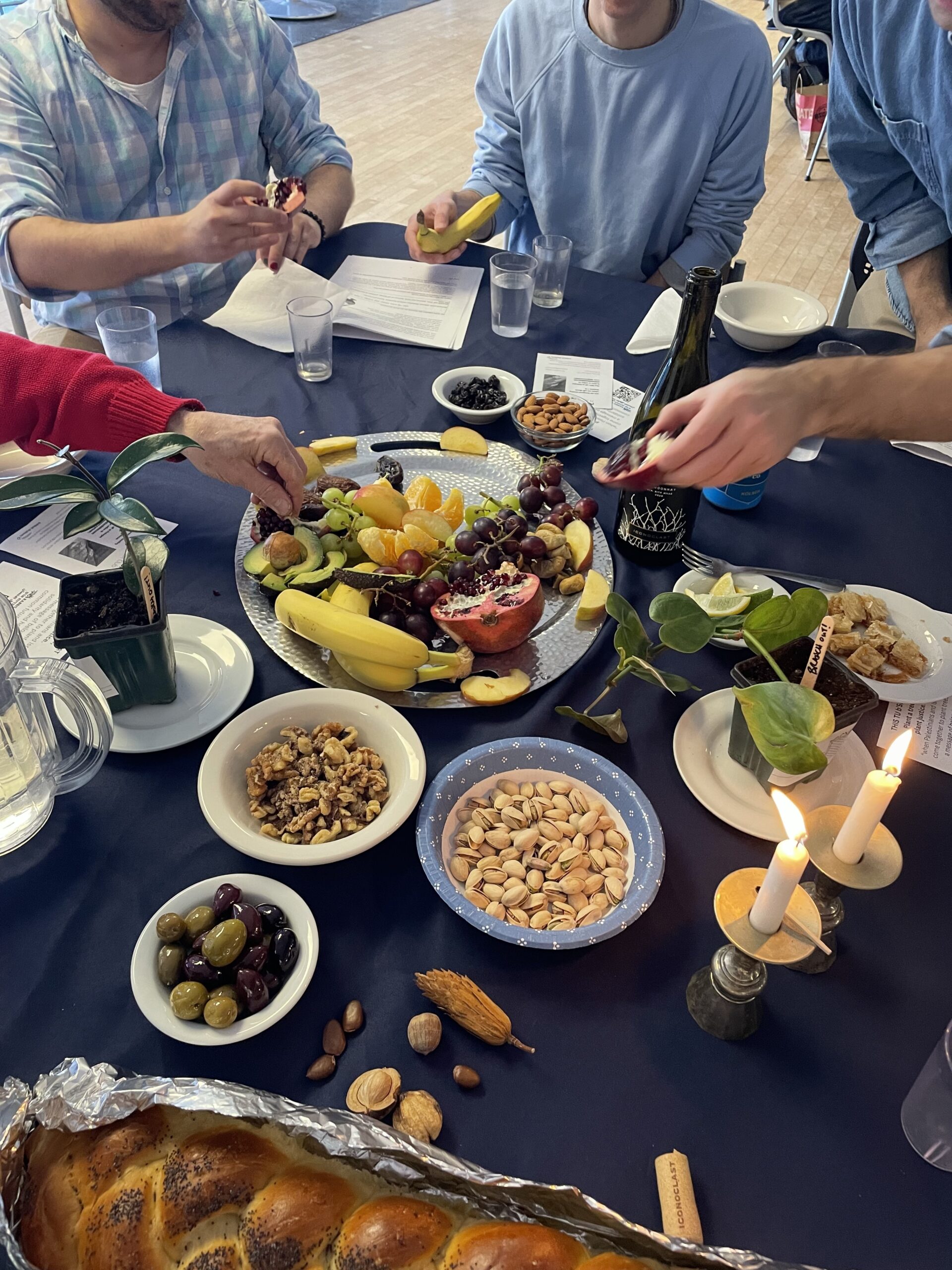
This past Sunday we gathered for our 20ish annual Tu b’Shvat seder. As a community rooted in eco-Jewish exploration and action, this somewhat obscure, oft-ignored holiday* is one we’ve always taken seriously. After taking last year off to give our leadership a break, we were reminded how much this gathering serves as an anchor for our collective values. In the future, we’ll work together to ensure we don’t miss another year.
As with any new year’s practice — be it resolutions set on January 1 or reviewing the marks we made and those we missed at Rosh haShanah — Tu b’Shvat invites us to perform deep inner work. Many of us don’t feel we have much capacity for that at this moment as we fight to preserve our democracy, protect our immigrant neighbors, sustain our vocations, and save our natural social ecosystems from threats of late stage capitalism.
But all that just proves the usefulness of rituals like the Tu b’Shvat seder. Every day we breath in harmony with the trees – they breath in what we breath out and vice versa. This happens whether we bring our awareness to it or not. For 2 precious hours we gave ourselves permission to enjoy the fruits of the trees of life and reflect on how we show up in the world – inside and out. We traveled through the four seasons with four differently colored cups of wine, we explored the four natural elements through poetry and music, and visited the four worlds of Kabbalah through dialogue with those gathered around our table.
For those who couldn’t be with us and those who want to linger a bit longer with Tu b’Shvat’s themes, here are a few postcards from the journey that might carry you through the last dark weeks of winter.
The World of our Actions (Assiyah/Winter/Earth)
Rabbi Tarfon said the Jewish people were like a pile of walnuts. If one walnut is removed, every walnut in the pile will be shaken. And when a single Jew is shaken, every other Jew is affected. In the same way, when a single species is endangered, the whole ecosystem is affected.
Regardless of religion or species, this is a great reminder that our actions ripple out into the world and impact the living things around us. Sometimes in ways we never see or know about – like a butterfly flapping it’s wings in Mexico and causing a tornado in Yellow Springs. So smile at your neighbors as you walk down the street, pick up trash when you see it, reach out to a friend you’ve lost touch with, and call your representatives!
The World of our Formation (Yetzirah/Spring/Water)
We live in the world of yetzirah, change, emotion, transformation. In this world we turn clay into bricks, iron into plows, words into poetry. In this sphere we celebrate creative power: ours and the Divine.
We’re all creative, despite what your schooling and socialization might have taught you. We have the power to make each moment, each interaction, into something more than the sum of its parts through the intention we bring to it. Consider how no one else in the world sees things quite like you. You have the potential to bring things into being that no one else can.
The World of our Creation (Briyah/Summer/Air)
A Talmudic story is told about Honi, who encountered an old man who was planting a tiny sapling. Honi laughed. “Foolish man,” he said, “do you think you will still be alive to eat the fruit of this tree?” The old man replied, “I found trees in the world when I was born. My grandparents planted them for me. So, too, I am planting for my grandchildren.”
This story reminds us that the future depends on our active hope. This kind of hope requires conscious and ongoing negotiation between pragmatic acknowledgment of the present and optimism about what could come next. It reminds us to act in full alignment with our values, in pursuit of our dreams, even if they never come true. Anything else would mean surrendering to pessimism and despair.
The World of our Imagination (Atzilut/Fall/Fire)
Physics tells us that what seems solid is actually filled with impossibly small spaces.
Next month, 7 members of our community will lead Shabbat services as part of an Adult Bnei Mitzvah ceremony. We’ll be sharing some of their stories in this space in the weeks to come. One reflected on her experience preparing in a way that embraces the spirit of the world of atzilut, highlighting the power of letting go of what’s no longer serving us and melting into what is, with all the beauty and pain that lies there.
“I had thought for a while that I might undertake this major rite of passage, though I imagined more learning than I think I am really capable of at age 83. So finally I am seeking to relax into what I can do with good will towards the whole venture – having an acceptance of myself as a simple student with an open heart and a curious mind. I am ready to expand in smaller ways as fits with my current impulses, opening to healthy new growth with a song ever ready to join in.”
We can’t save the world just by eating fruit, reading poetry, singing songs, and talking to our friends. But doing so might help us remember how much we are like our cousins the trees. Just like them, the world needs us to stand tall and branch out.
*Tu b’Shvat means “the 15th day of the Jewish month of Shvat” when it is celebrated and is often called The Birthday of Trees or Jewish Earth Day.